
Table of Contents
Need help with B2B Marketing?
Let the smarketers’ team drive your pipeline with data-led campaigns and AI-powered growth strategies.
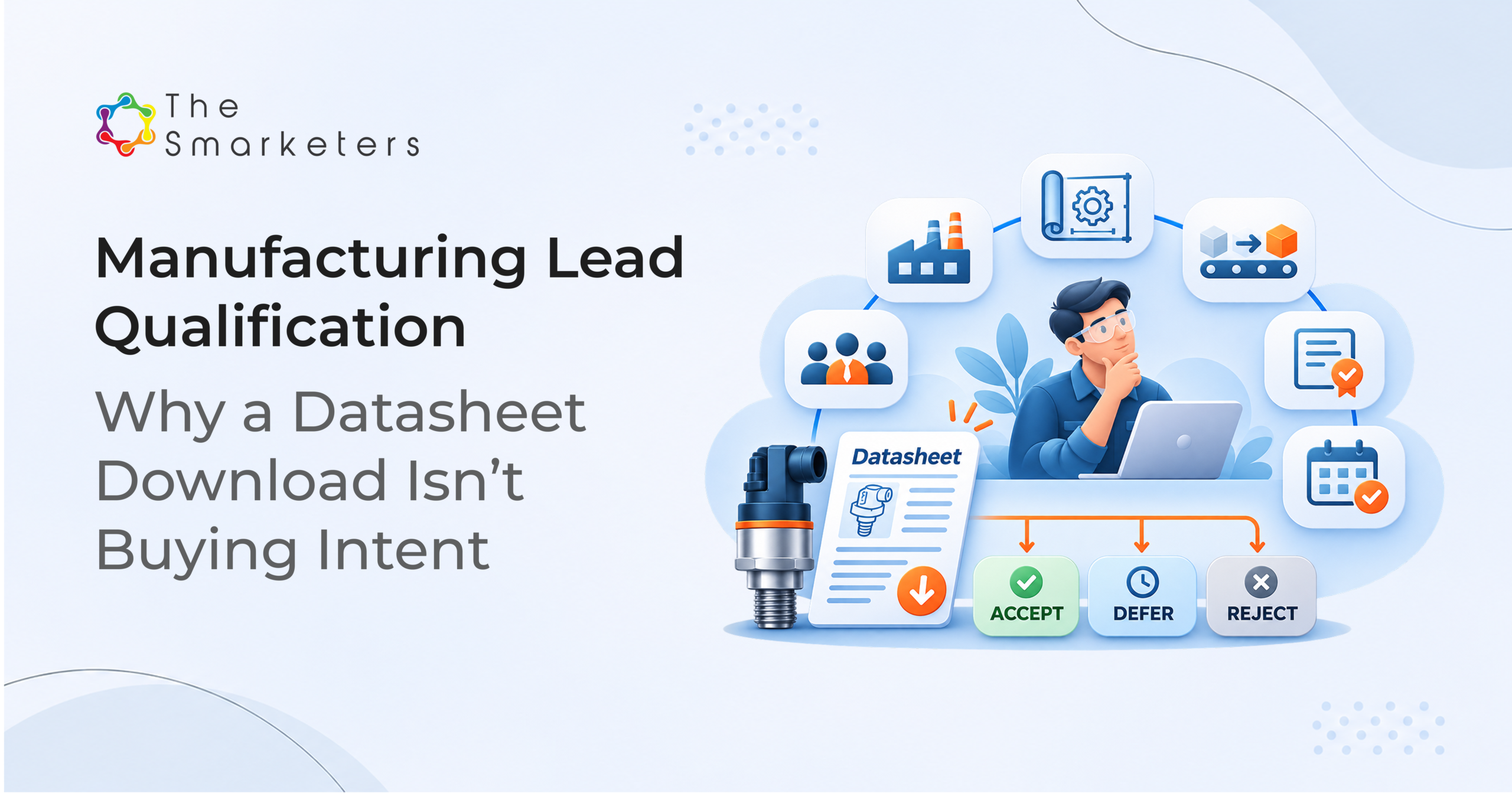
Quick answer: Manufacturing lead qualification is the process of deciding whether an enquiry reflects an active project worth sales time. A datasheet download alone doesn’t qualify a lead. Qualify on six signals: account fit, application context, project stage, proof requested, decision context, and an agreed next technical step. Then accept, defer, or reject each enquiry and log the reason.
Here is a common manufacturing lead qualification failure, shown as an illustrative scenario. A design engineer downloads the datasheet for your pressure sensor. Your marketing automation platform assigns points to the download, the contact crosses the marketing qualified lead (MQL) threshold, and a sales rep calls them the very next morning.
The engineer is courteous but confused. They were simply checking whether your operating range might suit a concept their team could explore next year. No one is making a purchase yet. The rep flags the lead as junk, while marketing is left wondering why sales refuses to follow up effectively.
Neither side made a mistake. The problem was treating an information request as active buying intent. In manufacturing, where technical documentation is often the very first resource a buyer inspects, that distinction is critical.
Below are six stronger signals to guide your qualification process, along with a practical approach for handling enquiries that are not yet sales-ready.
Why Isn’t a Datasheet Download a Buying Signal?
People download technical assets for plenty of non-buying reasons. Engineers benchmark specifications during early design exploration. Students and academic researchers gather datasheets for reference. Procurement teams verify documentation for current suppliers, and competitors routinely review your product specs.
A datasheet download is an information signal, not a buying signal. It only confirms that someone wanted information. It reveals nothing about whether an active project exists, whether it has budget, whether the contact holds decision-making influence, or when a purchase might occur. Routing every download directly to sales clogs the pipeline with premature conversations that cannot move forward.
How to Qualify Manufacturing Leads: 6 Stronger Signals
1. Account Fit: Score It Separately from Engagement
Account fit answers one question: is this the kind of company you can sell to? Check industry, company size, geography, supported applications, and whether they operate as an OEM, an end user, or a distributor.
Always track fit and engagement scores independently. An ideal-fit company that has not interacted yet is a strategic target for account-based marketing. A poor-fit company that has downloaded ten datasheets is merely a curious browser. Blending both into a single composite score makes those two completely different accounts look identical.
HubSpot’s lead scoring tool, for instance, lets you build separate fit and engagement scores, or a combined score that still keeps fit and engagement as their own values. Regardless of your platform, keep both dimensions distinctly visible.
2. Application Context: What Is the Buyer Designing or Building?
One of the highest-signal qualification questions in manufacturing is simply: “What are you designing or building?”
An enquiry noting, “We’re specifying a sensor for a new hydraulic test rig operating up to 400 bar” delivers far more actionable insight than a generic “please send pricing.” It clarifies the use case, the technical constraints, and roughly how mature the project is.
Include an optional application field on your enquiry forms, and coach whoever manages initial outreach to ask this question early.
3. Project Stage: Concept, Prototype, or Production?
Determine whether the buyer is in early concept exploration, active design, prototyping, full production, or sourcing a replacement for an existing component. Each phase calls for a tailored response.
Concept-stage contacts require technical guidance and patience. Prototype-stage enquiries typically need physical samples and rapid technical answers. Production-stage buyers are looking for pricing, lead times, and supply agreements. Identifying the stage upfront saves time for both your team and the buyer.
4. Proof Requested: What Evidence Does the Buyer Need?
Ask what evidence the buyer must review before progressing, whether that is test data, industry certifications, material declarations, a physical sample, a facility visit, or a technical consultation with an applications engineer.
A request for specific technical proof is one of the most reliable buying intent signals, far stronger than a passive download. It signals that the buyer is actively validating whether your product can meet their requirements rather than just gathering background reading.
5. Decision Context: Who Buys, and Through Which Channel?
Understand who else participates in the evaluation and how the organization purchases. An engineer may select the specification, while procurement issues the purchase order, a split that is typical of the industrial buying committee. A distributor might fulfill the transaction, or an existing client may already have a master agreement in place.
You do not need the entire org chart on the initial call, but confirming whether you are dealing with a net-new OEM, a current customer, or a channel distributor immediately determines who should own the follow-up.
6. Agreed Next Technical Step: The Clearest Early Buying Signal
The clearest early buying signal is a concrete next step the buyer actively commits to, such as scheduling a call with an applications engineer next Tuesday, requesting a test sample, or setting up a drawing review.
An agreed action demonstrates genuine buyer commitment and equips sales with a specific reason to follow up, rather than forcing a cold outreach tied to a PDF download.
The 6 Signals at a Glance
| Signal | Question to ask | What a strong answer looks like |
|---|---|---|
| Account fit | Is this a company we serve? | Target industry, size, and buyer type |
| Application context | What are you designing or building? | A named use case with technical constraints |
| Project stage | Where is the project today? | Prototype or production, not early concept |
| Proof requested | What do you need to see before moving forward? | Test data, certifications, or samples |
| Decision context | Who else is involved, and how do you buy? | A known route: direct OEM, distributor, or existing account |
| Next technical step | What happens next, and when? | A dated call, sample, or drawing review |
Manufacturing Lead Qualification Framework: Accept, Defer, or Reject
Once you evaluate enquiries against these six manufacturing lead qualification signals, every submission falls cleanly into one of three buckets. Always log the rationale behind the decision.
- Accept when the account is a strong fit and exhibits at least one higher-intent signal: a defined application, a request for specific proof, or an agreed next step. Route these directly to sales or an applications engineer.
- Defer when the account fits your target profile but the project is still early or undefined. Place these contacts into a relevant lead nurturing stream, such as technical content tailored to their application, and schedule a future check-in.
- Reject when the organization does not fit or the contact is not a prospective buyer (such as a student, competitor, or job applicant). Documenting the rejection reason helps refine your targeting over time.
Distributors and existing customers need dedicated lead routing paths. Route distributor enquiries straight to your channel manager, and direct existing customers to their account owner so they are never treated like cold prospects.
Here is an illustrative example of how three downloads of the exact same datasheet might be triaged:
| Enquiry | Signals | Decision |
|---|---|---|
| Engineer at a target OEM, concept stage, no application provided | Strong fit, but too early | Defer to application-specific nurture; revisit in 60 days |
| Engineer at a target OEM requesting high-temperature test data | Strong fit, specific proof requested | Accept; route to an applications engineer |
| University email address, no company listed | Not a commercial buyer | Reject: academic research or student |
Do You Need Manufacturing Lead Scoring at All?
Not always. Scoring models are useful for triaging large enquiry volumes, yet meaningful qualification still hinges on qualitative context, such as the specific application or proof requested, that automated scores cannot capture.
If you do implement scoring, keep fit and engagement distinct, weight recent interactions more heavily than older ones, and review the criteria alongside sales on a regular cadence. In HubSpot lead scoring, for example, you can configure engagement points to decay by a set percentage every 1, 3, 6, or 12 months so a cluster of downloads from last year does not keep an inactive contact looking sales-ready.
Next Step: Audit Last Month’s Datasheet Downloads
Export last month’s datasheet downloads and run a quick manufacturing lead qualification audit: classify every record into accept, defer, or reject using these six signals, documenting the reason for each. You will quickly uncover how many so-called “leads” were simply information requests and pinpoint exactly where your forms and initial discovery questions need refinement.
If you want support building structured qualification and routing workflows inside your CRM, our manufacturing marketing team can walk through it with you.
For the wider go-to-market picture, see our Manufacturing Marketing and GTM Playbook.
Frequently Asked Questions
What is manufacturing lead qualification?
Manufacturing lead qualification is the process of deciding which enquiries reflect an active project with a fit account, so sales and applications engineers spend time only on buyers who can move forward. It weighs account fit and buyer intent separately, rather than counting content downloads.
Is a technical download enough to open an opportunity?
No. A download reflects curiosity or information gathering, not an active buying cycle. Wait for stronger indicators, such as a defined application, a request for specific proof, or an agreed next technical step, before creating a pipeline opportunity or marking the contact as a sales qualified lead (SQL).
What if the engineer cannot disclose budget or timeline?
That is completely normal during early technical evaluations and should not disqualify the enquiry. Log budget and timing as unknown, focus on understanding the application and required proof, and lock in a clear next step. Commercial details usually surface once procurement enters the conversation.
Why doesn't BANT work well for early manufacturing leads?
BANT asks about budget, authority, need, and timeline. Early-stage engineers rarely know budget or timing, so strict BANT rejects real projects too soon. Treat need (application and proof requested) as the first gate, and log budget and timeline as unknown until procurement joins.
How should distributors and existing customers be routed?
Give each group its own dedicated workflow. Send distributor enquiries to your channel partner manager, and direct existing customers straight to their assigned account owner. Funneling either group through a net-new prospect queue wastes effort and risks damaging the relationship.

Shimon Joseph
VP of Growth and Partnerships