
Table of Contents
- Key takeaways
- What Is a B2B Full-Funnel Marketing Strategy?
- Why Do Shared Stage Definitions Come First?
- Who Should Own Each Funnel Stage?
- How Do You Find the Constraint in a Full-Funnel Marketing Strategy?
- What Should a Weekly Full-Funnel Review Cover?
- Why Keep a Written Decision Log?
- When Should a Funnel Issue Be Escalated?
- How Do You Report Contribution Without Claiming Causation?
- Where Do Agencies Fit in a Full-Funnel Program?
- Run the Constraint Check This Week
- Frequently Asked Questions
Need help with B2B Marketing?
Let the smarketers’ team drive your pipeline with data-led campaigns and AI-powered growth strategies.
A B2B full-funnel marketing strategy can appear healthy at every individual stage and still miss its targets. More often than not, the breakdown happens in the handoffs.
This usually plays out in a familiar way. Every segment of the funnel has capable people putting in real effort. Content and paid social generate awareness. Search and the website capture inbound interest. SDRs manage follow-up. Customer success focuses on renewals. Yet these functions operate with conflicting definitions, no one is accountable for the transitions between them, and the weekly sync turns into a slideshow of channel dashboards that wraps up without a single decision.
A true full-funnel program solves this by uniting every stage under one operating cadence: agreed definitions, a single named owner per stage, and a weekly review that consistently produces clear decisions. This guide walks through how to build that full-funnel marketing framework.
Key takeaways
- Most B2B funnels break at the handoffs, not inside individual stages.
- Agree on testable definitions for every handoff before you start reviewing reports.
- Give each stage one accountable owner, not a committee.
- Find the single constraint stage and focus effort there.
- Run a weekly review that ends in logged decisions, owners and dates.
What Is a B2B Full-Funnel Marketing Strategy?
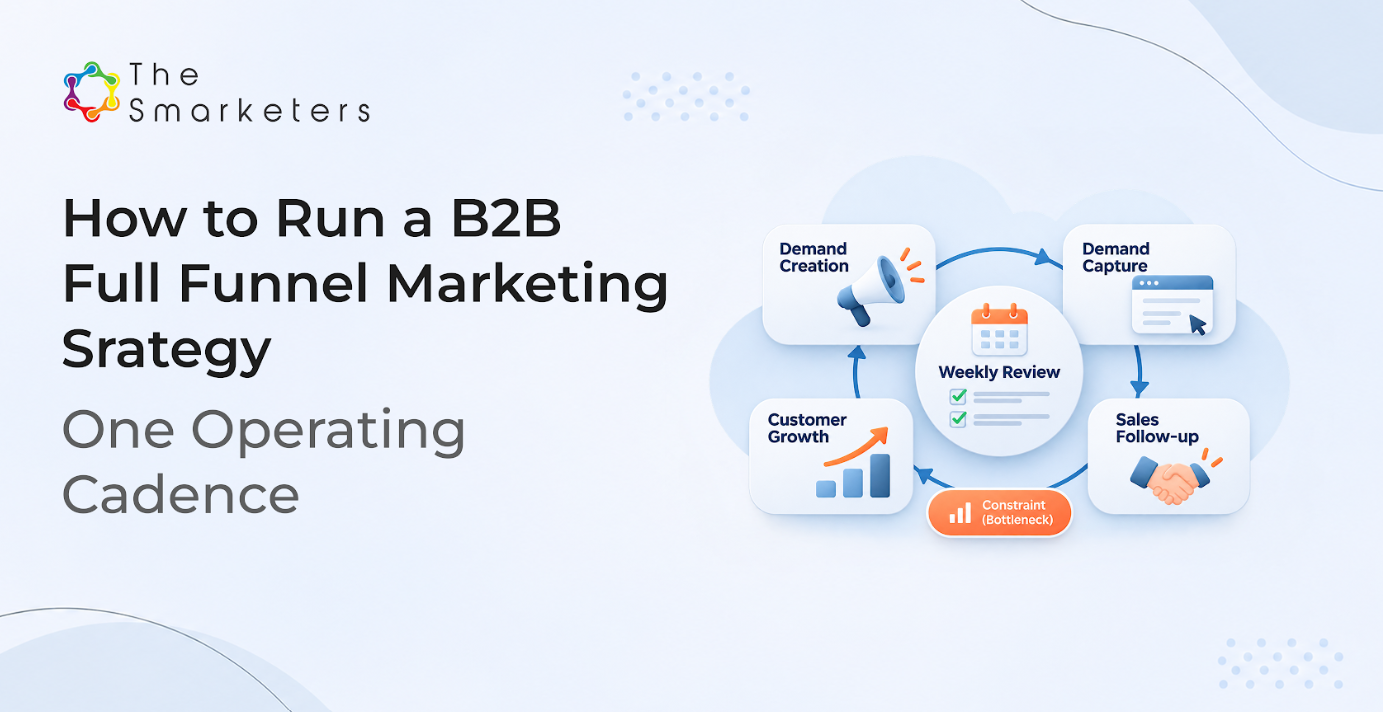
A B2B full-funnel marketing strategy manages demand creation, demand capture, sales follow-up and customer growth as one connected system. It runs on shared stage definitions, one accountable owner per stage, and a weekly review that ends in decisions. It links four B2B marketing funnel stages that organizations frequently run in silos.
Demand creation, the first half of B2B demand generation, builds familiarity and preference among prospective buyers who are not actively in-market yet. This spans thought leadership, category education, social content, and events.
Demand capture converts active buying interest into real conversations. Search, review platforms, your website, demo requests, and inbound routing all belong here.
Sales follow-up turns qualified inbound interest into pipeline opportunities and closed deals.
Customer growth retains and expands the accounts you have already won through onboarding, product adoption, renewals, and upsells.
The goal of a B2B full-funnel marketing strategy is not to divide resources equally across all four stages simultaneously. The goal is to manage them as a single connected full-funnel marketing engine so you can pinpoint whichever stage is currently constraining growth and focus your energy there. Our guide to demand creation vs. demand capture explores the first two stages in greater detail.
Why Do Shared Stage Definitions Come First?
No review cadence can function unless every department uses the same vocabulary to mean the exact same thing.
Document the exact handoff criteria between each adjacent stage, including the marketing and sales handoff. What signals confirm an engaged account is ready for capture efforts? What qualifies an inbound inquiry to be passed to sales? What criteria establish a formal opportunity? When does a newly signed client transition from onboarding to account growth?
Every definition requires an objective test that any two people would apply identically. “Marketing qualified” is too vague to be a definition. “A demo request or pricing inquiry from an organization in our target segment that is neither a current client nor an active opportunity” is specific and testable.
Next, assign a clear owner to each definition. When marketing alters qualification criteria without informing sales, sales and marketing alignment slips and the funnel silently breaks down. Our article on how to audit a sales and marketing SLA explains how to check a handoff once it is established, and our guide to RevOps for B2B teams details how to keep the underlying reporting aligned.
Who Should Own Each Funnel Stage?
Every stage requires a single person who owns both its performance and its outgoing handoff, never a committee.
This owner does not execute every task personally. Instead, they ensure the work gets completed, represent the stage’s metrics during the weekly review, and flag issues the moment a handoff begins to slip.
Below is one common way to structure ownership, though your exact setup will reflect your organization’s headcount:
| Stage | Accountable Owner | Owns the Handoff To | Handoff Metric to Review Weekly |
|---|---|---|---|
| Demand creation | Head of marketing or brand lead | Demand capture | Engaged target accounts |
| Demand capture | Demand generation lead | Sales follow-up | Qualified inquiries accepted by sales |
| Sales follow-up | Sales leader or SDR manager | Closed deal and onboarding | Accepted inquiries converted to opportunities |
| Customer growth | Customer success leader | Renewal and expansion pipeline | Renewal rate and expansion pipeline |
When an external agency supports part of the program, it can manage execution within a given stage. However, strategic decisions regarding qualification, follow-up, and deal progression must remain in-house. We unpack that boundary further below.
How Do You Find the Constraint in a Full-Funnel Marketing Strategy?
At any given time, one stage acts as the primary funnel bottleneck for the entire program. Investing heavily anywhere else yields far smaller returns.
To locate the bottleneck, examine the handoffs rather than individual channels. Walk through four diagnostic questions alongside your sales and customer success leaders:
| Question | If the answer is no, the constraint is | What to inspect |
|---|---|---|
| Are enough target accounts aware of your brand and engaging with it? | Demand creation | Awareness and engagement across your target accounts |
| Among those engaged accounts, are enough actively raising their hand? | Demand capture | Your website, offers, search presence, and inbound conversion paths |
| Among qualified inquiries, are enough converting into pipeline opportunities? | Sales follow-up | Follow-up speed, qualification rigor, and sales bandwidth |
| Among the customers you win, are enough renewing and expanding? | Customer growth | Onboarding, adoption, and renewals. Pouring more budget into acquisition will not solve this. |
Consider an illustrative scenario. A company ramps up paid media spend because pipeline feels light. After running through these four questions, leadership discovers that inbound demo requests are actually strong, but a large percentage sit untouched for days before anyone reaches out. The bottleneck is sales follow-up, not demand. Increasing ad spend would only compound the problem.
What Should a Weekly Full-Funnel Review Cover?
The weekly review anchors the entire revenue operating cadence. Keep it brief, ground it in data, and require it to conclude with concrete decisions.
Use this five-part agenda:
- The constraint stage first: Open with the stage currently acting as the bottleneck. What shifted over the past week, and is the active fix showing results?
- Handoff health: Review the agreed metric for every transition. How many inquiries did sales accept or reject, and for what reasons? How many accepted inquiries progressed into opportunities?
- Exceptions: Flag anything falling outside established rules: unassigned leads, rejections lacking a documented reason, or accounts stalling between stages.
- Decisions: Define what will change this week, assign an owner, and set the date to evaluate the outcome.
- Escalations: Surface any blockers that require sign-off from leadership outside the meeting.
Channel-level metrics, like click-through rates, cost per lead or email open rates, should only enter this meeting as diagnostic context. If demand capture is the current constraint, paid search CTR might help pinpoint the cause. On its own, however, a channel metric is not a decision.
Why Keep a Written Decision Log?
Every weekly review should generate a concise written log. For each decision, record what was agreed, who owns execution, when it will be revisited, and what evidence will confirm whether it succeeded.
While this may feel like administrative overhead, it is the mechanism that actually drives improvement. Without a written decision log, the exact same problems resurface every week and no one can tell whether last month’s adjustment made a difference.
When Should a Funnel Issue Be Escalated?
Certain blockers cannot be resolved by the attendees in the weekly review. Establish clear escalation triggers and recipients ahead of time.
Strong escalation triggers include a handoff metric falling below target for three consecutive weeks, an unresolved definition dispute between sales and marketing, a staffing gap such as lacking SDR coverage for a newly launched segment, or a proposal to reallocate budget across stages.
Specify exactly who receives each escalation, such as the CRO or CMO, along with their expected turnaround time for a decision.
How Do You Report Contribution Without Claiming Causation?
Running a full-funnel program generates abundant data showing which touchpoints preceded which outcomes. While valuable, sequence is not the same as proof of causation.
When reporting performance, describe what you observed, for instance, accounts that interacted with demand creation content and subsequently converted into opportunities. Avoid asserting that the content directly caused those deals, as prospects who were already in-market are naturally more inclined to engage.
Whenever you need to verify whether a specific initiative truly moved the needle, set up an incrementality test, such as a holdout group or a matched control set of accounts excluded from the activity, and be transparent about the degree of uncertainty.
Where Do Agencies Fit in a Full-Funnel Program?
Whether you run an end-to-end B2B marketing program or use several specialists, external partners add the most value when roles and boundaries are explicitly defined.
An agency or specialist vendor can take ownership of execution: launching campaigns, developing content, managing paid channels, and assembling reports. They can also contribute insights on performance and propose adjustments during the weekly review.
Your internal team, however, must retain ownership of core commercial decisions: defining a qualified buyer, shaping sales follow-up, choosing which opportunities to pursue, and structuring customer renewals. Those calls rely on internal business context that an outside partner cannot fully see.
If you are weighing different agency engagements, our guide to evaluating a full-funnel B2B marketing agency outlines the key questions to ask.
Run the Constraint Check This Week
Gather your sales and customer success leaders and work through the four constraint questions together. Align on which stage is currently limiting overall performance, assign a single owner to it, and convene your first weekly review focused on that stage.
If you want hands-on support establishing shared definitions, stage ownership, and a decision-driven review cadence, our full-funnel marketing services team can build it alongside you.
Frequently Asked Questions
What is full-funnel marketing in B2B?
Full-funnel marketing in B2B manages demand creation, demand capture, sales follow-up and customer growth as one connected system rather than as separate channel programs. Success is measured at the handoffs between stages, not only within each channel.
How is full-funnel marketing different from demand generation?
Demand generation covers the first two stages, creating and capturing demand. Full-funnel marketing also includes sales follow-up and customer growth, so it tracks how interest turns into pipeline, revenue, renewals and expansion.
Which decisions should belong to sales rather than the agency?
Qualification criteria, follow-up cadence, deal strategy, and opportunity prioritization. While an agency can recommend adjustments, sales must own these decisions because they hinge on rep bandwidth, pricing flexibility, and direct buyer conversations outside the agency’s view.
What if stage definitions are inconsistent across teams?
Pause and align on definitions before launching the weekly review, beginning with the handoff to sales. Frame each definition with an objective test that any two people would apply identically, assign an owner, and log the effective date. Reviewing reports built on conflicting definitions simply drags the debate into the meeting.
How do we include customer growth without counting it as acquisition?
Manage it as a distinct stage with dedicated metrics, including onboarding completion, renewal rates, and expansion pipeline. Keep expansion deals clearly separated from net-new pipeline in all reporting so strong growth from existing accounts does not mask a slowdown in new customer acquisition.
How do we keep a specialist vendor in the model?
Assign them a defined scope within one or more stages, include them in the weekly review for those specific areas, and clarify which decisions they advise on versus which they own. Require all of their reporting to follow the exact same definitions used by the rest of the team.

Enoch Pakanati
CEO